You’re okay, the car isn’t: what to do after a wreck in Arizona
Stop the car. Check yourself and anyone riding with you for injuries. Then get off the road if you can. That’s the first thirty seconds, and if you do nothing else in the right order, do those three — everything that comes after is phone calls and paperwork, and paperwork has never hurt anybody.
The rest of this is the after: what Arizona actually requires of you, what protects you later, and the one honest question — will my car drive or do I need a tow. A wreck can scramble your thinking and it helps to have walked through it once while your hands weren’t shaking. So let me walk you through it once now.
First, the only question that matters: is anyone hurt?
Not the bumper. Not whose fault. Not what your insurance is going to say. People — you, your passengers, the other driver, anyone who was on foot or a bike nearby. If the answer is yes, or you’re not sure, call 911 before anything else, and don’t move anybody who’s badly hurt unless they’re in active danger where they sit. Let the paramedics do that part.
If everybody’s walking and talking, you’ve cleared the hard part. Now you can think about the car.
Get the car out of the lane — the law actually says so
This is the piece most people don’t know, and it trips them up: in Arizona, if nobody’s seriously hurt and your car still drives, you’re supposed to move it out of the travel lane. It’s Arizona’s “quick clearance” law, and it says the drivers involved shall move their vehicles out of the main road into a safe spot — the shoulder, the median, an emergency lane — as long as two things are true. One, you can do it safely. Two, the car can actually be driven normally, under its own power. A drivable car sitting in a live lane is how a fender-bender turns into a pileup, and the law would rather you not be the reason.
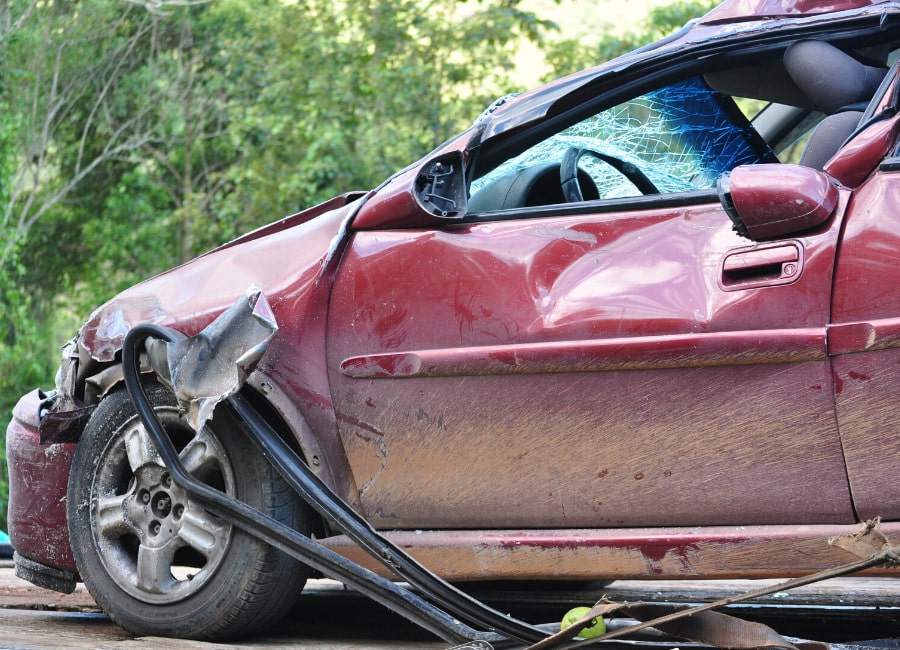
So the rule of thumb is, If it rolls and steers and there’s nothing dragging, ease it to the shoulder and turn your hazards on. If it won’t roll, or the wheel’s cocked sideways, or there’s fluid on the ground and metal folded into the tire — leave it, get yourself clear, and flag it. That second car is the one that needs us. More on that in a minute.
What Arizona says you have to do
The legal duties after a crash aren’t complicated, but skipping them is one of the easiest ways to turn a bad day into a criminal one.
You have to stop and stay. Whether it’s a scratch on somebody’s door or something far worse, Arizona law requires you to stop at the scene and remain there until you’ve done your part. Driving off is the crime everybody knows by its old name — hit and run — and the state does not treat it lightly. Leave a property-damage crash and it’s a misdemeanor. Leave one where somebody got hurt or killed, and it’s a felony, with prison time and a license revocation that can run a decade. The car is never worth that. Not close.
You have to trade information. By law you give the other driver your name, your address, and your vehicle’s registration number, and you show your license if they ask. They owe you the same. If anybody’s hurt, you’re also required to give reasonable help — which mostly means calling for the people who can actually help and staying with the injured until they arrive.
You have to call the police when it’s serious. If anyone’s injured or killed, Arizona requires you to notify law enforcement right away, by the fastest means you’ve got — that’s the 911 call again. For a minor scrape with no injuries you’re not strictly required to summon an officer, but calling is almost always the smart move, and once the damage crosses two thousand dollars or anybody gets a ticket, the investigating officer has to write a full report anyway. When in doubt, call. A report you didn’t need is a minor annoyance. A report you needed and don’t have is a real problem.
One more that catches good people off guard: back into a parked car in a lot, or clip somebody’s mailbox, and no owner’s around? You can’t just drive off because nobody saw. The law treats an unattended vehicle the same way — find the owner, or leave a note with your name and contact information. A napkin under the wiper has kept more than one honest person out of a hit-and-run charge.
Get it documented while it’s fresh
Your memory of a crash is worse than you think, even ten minutes later. So before the cars get moved and the adrenaline drains off, get your phone out.
Photograph everything — both cars from a few angles, the damage up close, the plates, the whole scene wide enough to show where things sat and which way they were pointed. Skid marks, broken glass, a stop sign hidden behind a tree, the light that was green. Get the other driver’s information and their insurance, and if there were witnesses who stopped, their names and numbers are gold. If an officer works the scene, ask how to get a copy of the report. And if it was minor enough that nobody came out — no injuries, just two cars — you may be able to file a Citizen’s Collision Report through the Arizona Department of Public Safety, which gives you an official record even without an officer on scene.
None of this is for the lawsuit you’re not going to have. It’s so that three weeks from now, when a stiff neck shows up or a story changes, the facts are already sitting in your pocket where nobody can argue with them.
So who moves the car?
Here’s where we come in.
If the car still drives, drive it — the law wants it out of the lane, and a working car doesn’t need a tow truck. But if it’s the second kind — wheels that won’t turn, a frame that’s bent, airbags blown, fluid running down the asphalt — that’s a recovery. A car hauled off the road and set down at a shop or your driveway is a solved problem.
And one thing nobody tells you, so I will: you often get a say in who tows it. If the police are running an active scene — injuries, an investigation, traffic to direct — they may call whoever’s next up on the rotation, and in that moment you might not get to choose. Fair enough; they’ve got a road to clear. But a minor one, no injuries, the car just won’t drive and nobody’s directing traffic on your behalf? You can call the tow you want. You are not stuck with the first truck that circles the block, and you are not obligated to whatever number an app or a call center hands you before you’ve had a second to think. Pick who moves your car. Ideally us — but pick.
The call we’re glad to get
There’s a post I wrote about floods where I said I’d rather talk you out of ever needing us. This is the other kind. Nobody plans a wreck, and the ten minutes after one are miserable no matter what — but if everybody’s okay and the only casualty is sheet metal, then the tow is the small part, and it’s the part we’re actually glad to handle for you.
So if you’re standing on a shoulder somewhere north of the valley, hazards blinking, a car behind you that isn’t going anywhere on its own — you’re already through the worst of it. Take the pictures. Trade the information. Get yourself somewhere safe. Then you know the number.
Sources (for the record)
- ARS § 28-661 — duty to stop and remain after an accident involving injury or death; leaving is a felony (class 2–5) with license revocation up to ten years.
- ARS § 28-662 — duty to stop and remain after a property-damage crash involving an attended vehicle; leaving is a misdemeanor.
- ARS § 28-663 — duty to give information (name, address, vehicle registration number), show a license on request, and render reasonable aid to the injured.
- ARS § 28-664 — duty on striking an unattended vehicle: locate the owner or leave your name and contact information.
- ARS § 28-666 — duty to notify law enforcement immediately, by the quickest means, after an accident involving injury or death.
- ARS § 28-667 — investigating officer must complete a written report for injury, death, property damage in excess of $2,000, or the issuance of a citation; report due within 24 hours (threshold raised from $1,000 to $2,000 by SB1223).
- ARS § 28-674 — “quick clearance”: drivers shall move drivable vehicles out of the main travel lane to a safe refuge when no serious injury or death is apparent, if it can be done safely and the vehicle does not require towing.
- Arizona Department of Public Safety — Citizen’s Collision Report available for minor crashes (no injuries, no more than two vehicles) when no officer responds.