Elk on the 17 and the 40: what to do if you hit one
It’s dusk somewhere past Munds Park, the light’s gone flat and gray, and the dark shape on the shoulder you were half-watching stands up, turns out to be the size of a horse, and steps into your lane. Brake hard. Stay in your lane. Keep the wheel straight.
Sometimes you can miss it, but sometimes there isn’t time for any of that, and the elk wins. When it does, the ten minutes afterward can be scarier than the new dent in your vehicle, and you’ll be running on adrenaline. So walk through them once now, on a quiet evening with nothing at stake, and the order of things will already be in your head on the night you need it.
An elk is not a big deer
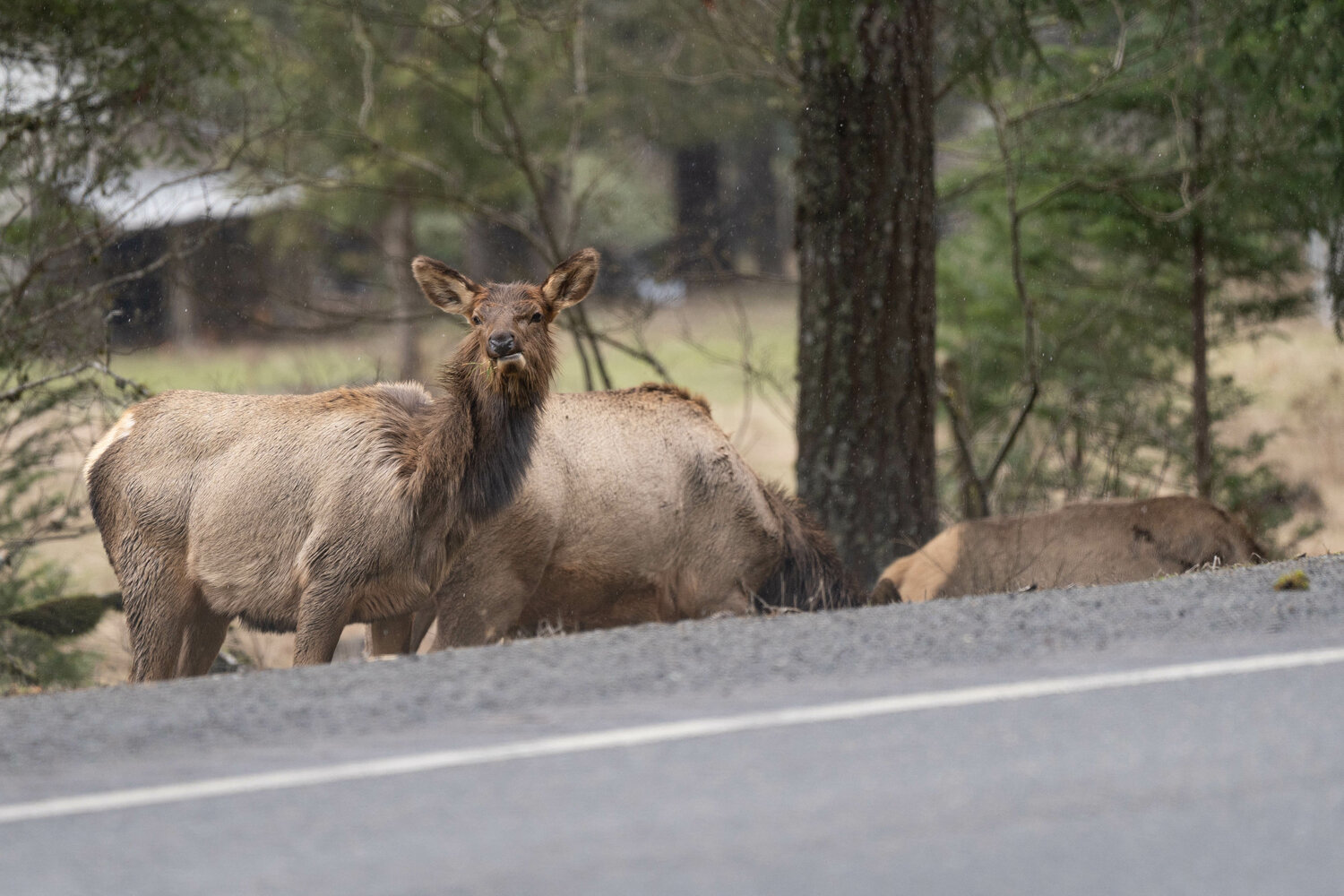
Most of us learned to drive thinking about deer. Elk are a different animal, literally. The Arizona Department of Transportation puts the average bull at about 900 pounds and the average cow around 500 — and the trouble isn’t only the weight, it’s where the weight sits. Those long legs put the body right at windshield height. A Flagstaff Fire captain once described it about as plainly as it can be put: the car takes out the legs, and the rest of the animal comes up over the hood and into the glass.
Statewide, Arizona logged 1,830 vehicle-animal crashes in 2022, with four people killed and 280 hurt. Not all of them elk. Plenty of them were.
Stay in your lane — almost always
The official advice from Arizona Game and Fish is the advice your gut hates: typically, don’t swerve. Stay in your lane and brake firmly. The reason is simple and grim. A swerve trades a collision with an animal for a collision with a tree, a guardrail, a ditch, or another vehicle — and the Federal Highway Administration points out that a lot of wildlife crashes aren’t caused by the animal at all, but by the attempt to miss it.
Game and Fish does carve out one honest exception. With a very large animal like an adult bull elk, and no oncoming traffic, and a safe shoulder on both sides, swerving may be safer than taking that impact head-on. That’s three conditions you’ll be checking in about one second, in the dark. If you can’t see all three, the answer is brake and stay straight.
And when you see one, look for the next. Elk and deer move in groups, and the one that crossed is rarely the only one thinking about it.
Where and when it happens
If you drive the 17 between Stoneman Lake Road and Flagstaff, you’re on what Game and Fish research has flagged as the worst road in Arizona for elk collisions. One stretch south of town near Willard Springs accounted for 58 percent of the wildlife-vehicle crashes between Stoneman Lake and Flagstaff from 2018 to 2022 — something like a hundred deer and elk incidents a year, by Game and Fish’s count. Interstate 40 between Williams and Flagstaff and SR 64 up to the Grand Canyon are on the agencies’ watch list too.
The good news is the state’s been doing something about it. In 2012, ADOT and Game and Fish fenced four spots on the 17 near Munds Park, and elk crashes there went from twenty in four years to one. The new Willard Springs wildlife overpass at milepost 327 — a hundred feet wide, with miles of fencing on both sides to steer animals onto it — is scheduled to wrap up this fall. It’ll help. But Game and Fish expects it’ll take a couple of years for the herds to really learn to use it, and every fence ends somewhere. The road past the end of it is still yours to watch.
As for when: dusk and dawn, and the dark in between. ADOT says it’s not unusual for a dozen wildlife strikes to happen across the high country between sunset and sunup in a single night. If you’re coming down the hill after dark, ease off the speed and buy yourself a couple more seconds to react. It’s the cheapest insurance you’ll ever carry.
If you’ve hit one: the order that keeps you safe
Get the car out of the lane if it still drives. Same rule as any wreck in Arizona: if nobody’s seriously hurt and the car runs and steers, ease it to the shoulder and get the hazards on. If it won’t, leave it where it is and get yourself clear of traffic. (I walked through Arizona’s quick-clearance law in our post on what to do after a car accident in Arizona.)
Check on people first. Anyone hurt, or you’re not sure — that’s a 911 call before anything else. Elk crashes put people in the hospital, and the windshield ones are the worst of them.
Stay away from the animal. I know the pull, especially if it’s suffering. Don’t. A hurt elk can still kick, and those hooves are a long way from harmless. Arizona’s salvage law is written around a peace officer or Game and Fish making the call on an injured animal — not you with a tire iron. And don’t try to drag 900 pounds out of a live lane in the dark. Let the people with lights and vests handle the road.
Call it in. Hitting an elk is a collision like any other, and Arizona’s rules don’t care that the other party had antlers. If anyone’s hurt, you’re required to notify law enforcement right away. Even if nobody is, it’s worth the call — a dead elk lying in a travel lane is a hazard for whoever comes over the rise behind you, and if an officer works the scene and the damage tops two thousand dollars, they’ll write the full report your insurance is going to want. An elk clears that bar without trying; one Arizona study put the average elk-vehicle collision at roughly seventeen and a half thousand dollars.
Take the pictures. The car, the animal, the scene, the nearest mile marker, the yellow sign you may or may not have noticed. Your insurer will want them, and three weeks from now, so will you.
And yes — the meat. It’s legal in Arizona, with a permit. Under ARS 17-319, a peace officer or a Game and Fish employee can issue a big game salvage permit to the driver, or to anyone else who wants the carcass, as long as the animal isn’t suspected of being diseased or spoiled. The permit comes first. Load it up and plan on sorting out the paperwork later, and you’re not a salvager — you’re a poacher with a dented truck.
Drive it or tow it?
Here’s the thing about elk damage: it lives in the front of the car, and the front of the car is where the parts are that keep your engine alive. A buckled hood is cosmetic. A radiator with a hole in it isn’t — and a car that seems perfectly drivable on the shoulder can cook its engine in the next few miles of grade.
So leave it if you see any of this: fluid puddling under the front, steam, a temperature gauge climbing, a hood that won’t latch, a headlight out on a dark highway, a cracked or caved windshield, or anything rubbing a tire. That car is a tow — and getting it off a mountain shoulder and down to a shop or your driveway is the easy part of a hard night.
Same as any wreck: if police are running the scene, they may call whoever’s up next on the rotation, and that’s their call to make. If they’re not — no injuries, nobody directing traffic on your behalf — you choose who tows your car. Pick someone you trust. Ideally us. But pick.
The ones who walk away
Fifty-some years of towing this town means we’ve hauled our share of cars off the 17 with elk hair still caught in the grille. The cars are usually a mess. The people, more often than you’d think, walk away — and most of the time, they’re the ones who braked hard and held their lane.
So slow down after sundown, watch the shoulders, and when one steps out, brake and hold the line. And if the elk wins the argument with your front end anyway, get yourself somewhere safe, make the calls, take the pictures. Then you know the number.